The battery truth behind Ethiopia's electric future.
Independent, engineering-grade EV battery-health certification — built for the locked, imported fleet now filling the streets of Addis Ababa.
A partnership briefing for insurers, importers, banks, government agencies & investors — Addis Ababa.
Powered by the Grand Ethiopian Renaissance Dam (GERD) — abundant, low-cost, clean hydropower to charge an entire national fleet. Sources: IEA policy database · UNECA — Ethiopia National E-Mobility Strategy 2025–2030 · press reporting, 2024–2026.
Two tests. One certificate everyone can trust.
From a quick dealer-lot check to the accuracy benchmark banks rely on — every result ends in the same signed, verifiable document.
RISIQ Rapid Check
A short, controlled partial-charge measurement, mapped to full State-of-Health by optimization models trained on our own Ethiopian reference dataset. Built for dealer lots, bank valuations and insurance checks.
RISIQ Reference Test
A full charge session measured end-to-end with a revenue-grade calibrated meter — targeting ±3% accuracy. The benchmark every Rapid Check is validated against, for high-stakes decisions.
RISIQ Certificate
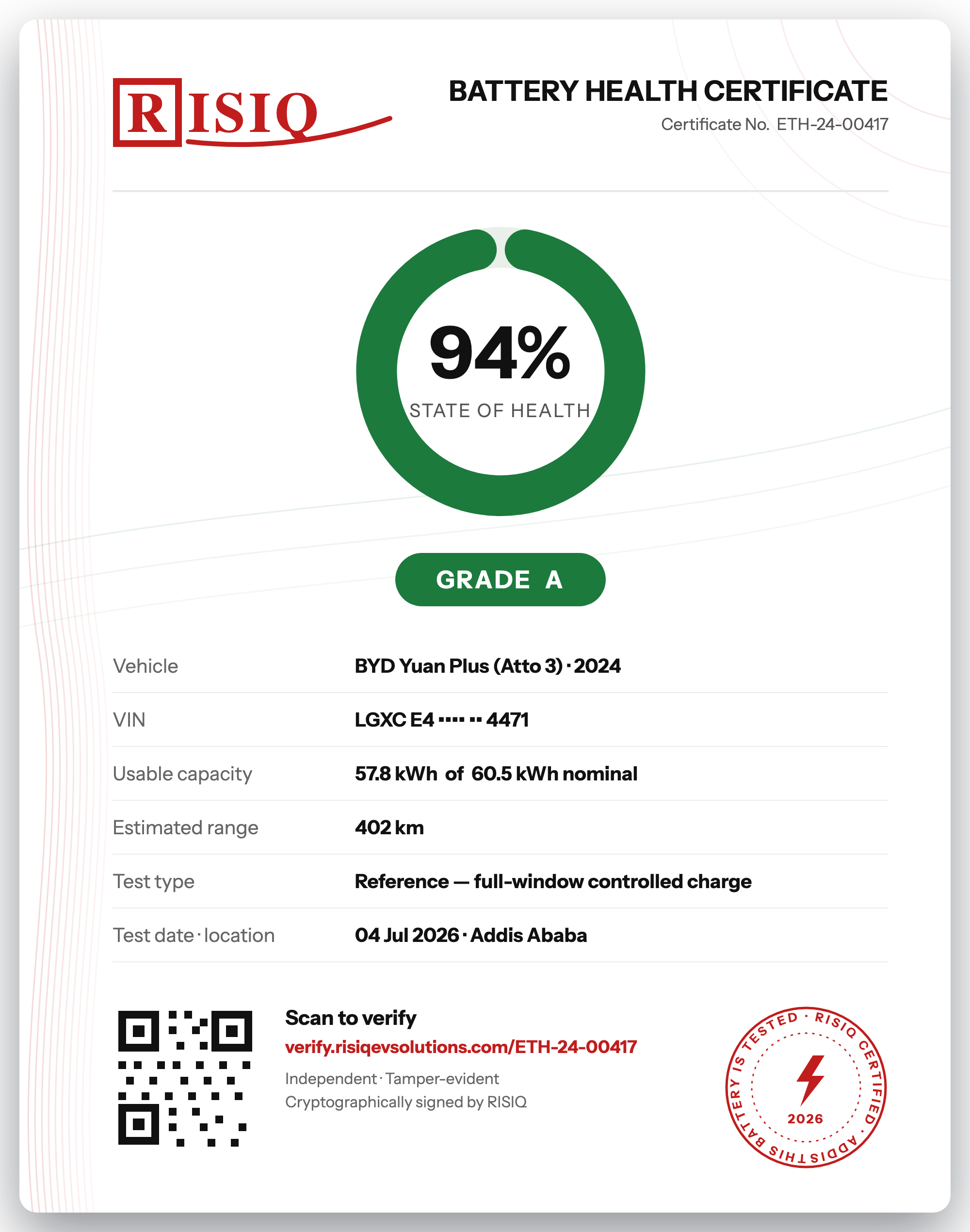
A signed, QR-verifiable document with State-of-Health, usable capacity, estimated range and a clear A–D grade — designed to be underwritten, lent against and sold on.
See what's insideFor an EV, the odometer tells you almost nothing.
An electric motor has one moving part — it can outlast the whole car. The battery cannot. It quietly loses capacity to heat, fast-charging and hard use — and the battery is 40–50% of the vehicle's value. So mileage, the number everyone still trusts, is the wrong number.
Same 50,000 km. Same price on paper. Wildly different batteries.
50,000 km on the odometer
Home-charged overnight, kept cool, easy commuting.
50,000 km on the odometer
Fast-charged daily to 100%, parked in the sun, driven hard.
Everyone is pricing a battery no one can see.
Insurers
No way to price battery risk at underwriting or at claims. Policies become guesses — mispriced risk and fraud slip straight through.
Banks & MFIs
Five-year auto loans against an asset that can lose half its value in two. Unpriceable collateral makes financing the #1 barrier to EV adoption.
Importers & Dealers
Grey-market imports, no OEM service centres, no proof of health. Buyers hesitate, disputes follow, good used EVs sit unsold.
Government & Fleets
Consumer protection, road and fire safety, and safeguarding the hard currency the whole EV pivot was meant to save.
The usual test goes blind here. Ours doesn't.
Reading the car's computer
The common method asks the battery's own computer over the OBD port. But that computer can read optimistically — or be reset to hide damage — and Chinese EVs (BYD, Changan, Jetour) encrypt it. No password, no reading.
Measuring the electricity
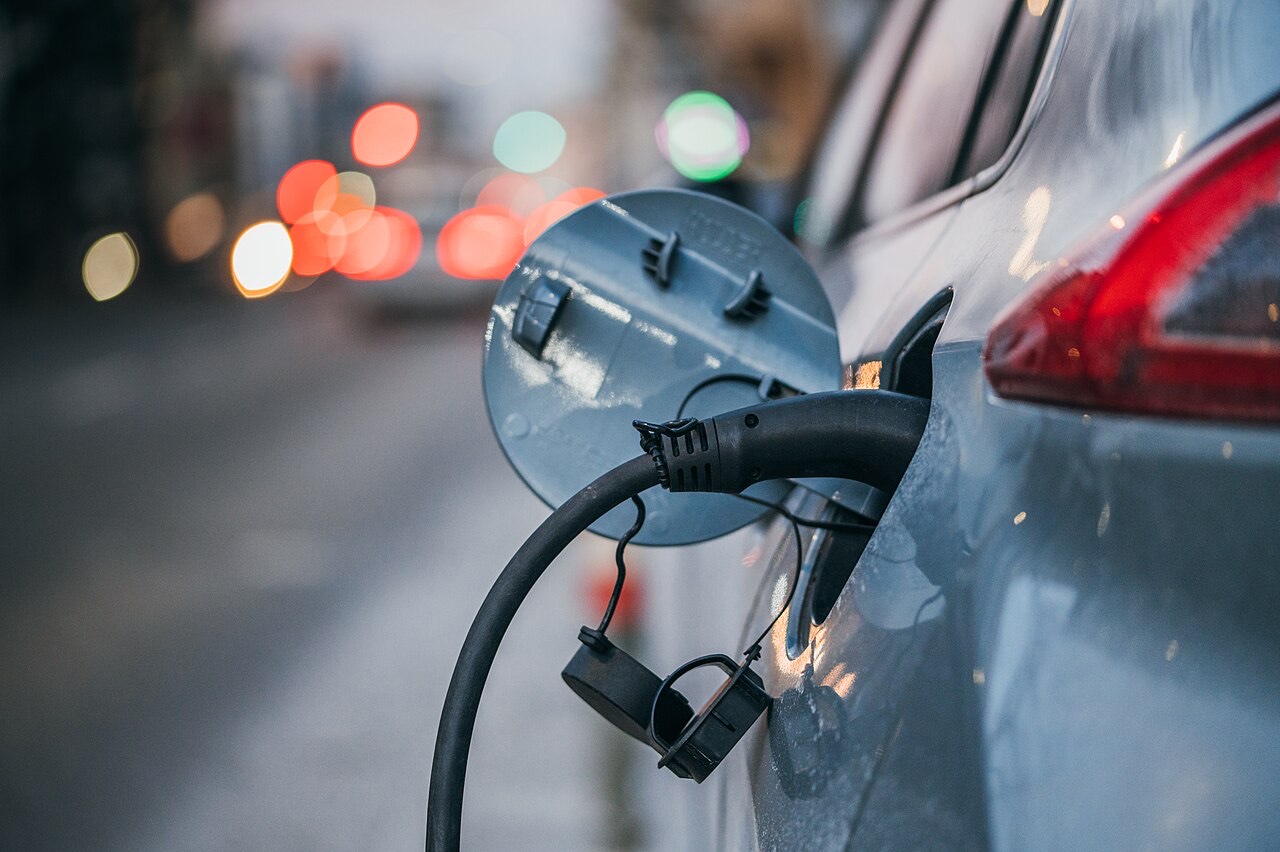
RISIQ runs a controlled charge at the car's charging socket and measures the real energy flowing in with a precision meter. Electricity behaves the same in every car — so the test works on any locked, imported EV.
Like a treadmill stress test, not reading an old medical file — the physical measurement reveals the truth the computer can hide.
A battery-health certificate institutions can trust.
Every RISIQ test ends in one thing: a verifiable certificate that turns an invisible battery into a number you can underwrite, lend against, and sell on.
- A measured State-of-Health % — grounded in precision electrical measurement, not a figure self-reported by the car.
- Tamper-evident & signed — cryptographically sealed; edit the PDF and verification breaks.
- QR-verifiable in under 2 seconds — anyone can scan and confirm against a public record.
- Usable capacity, range & grade — a clear A–D grade a buyer or lender understands at a glance.
In Europe, a certified EV sells for hundreds of euros more — and faster. In Ethiopia, this certificate is the missing layer of trust.
Fifteen minutes, at your site.
No OEM cooperation. No workshop downtime. A precision measurement, a signed certificate.
Plug in
Connect the RISIQ rig at your workshop, importer yard or fleet depot.
Measure
A controlled charge; a precision meter reads the real energy going in. Fast test ≈ 15 min.
Compute
The RISIQ cloud derives State-of-Health to ±3% through deep electrical engineering and optimization-based analytics.
Certify
A signed, QR-verified certificate is issued on the spot.
Built for Addis. If the cellular network drops mid-test, the rig stores the data and forwards it when the link returns — a dropped connection never invalidates a result.
See the full processA first-mover window — and no one else is in it.
The method needs no manufacturer's permission — so it works on the exact cars flooding Addis. And every certificate deepens a local dataset that no foreign entrant can copy.
How RISIQ compares to the existing players.
Battery diagnostics is a proven category in Europe — AVILOO, TWAICE, Volytica, DEKRA. None of them are built for the market Ethiopia actually has: locked Chinese imports, intermittent connectivity, and institutions that need a certificate, not a dashboard.
| Capability | RISIQ — socket measurement | OBD / BMS-based certifiers | Fleet analytics platforms |
|---|---|---|---|
| Measurement source | Independent precision meter at the charging socket — direct electrical measurement | The vehicle's own battery computer, read over the OBD port | OEM / telematics data feeds from the vehicle |
| Locked Chinese imports (BYD, Changan, Jetour) | Works — no OEM access needed | Frequently blocked by encrypted BMS protocols | Requires manufacturer data cooperation |
| Independent of the car's self-reported figures | Fully — energy is measured, not asked for | Partially — depends on BMS honesty and per-model decoding | No — built on vehicle-reported telemetry |
| Presence in East Africa | Addis Ababa — built for this market | None | None |
| Works with unreliable connectivity | Yes — offline store-and-forward by design | Varies | Cloud-dependent |
| Primary output | Signed, QR-verifiable certificate for banks & insurers | Battery certificate (European used-car market) | Fleet monitoring dashboards & analytics |
| Billing & currency | Locally in birr, via Telebirr | EUR / USD, European channels | Enterprise SaaS contracts |
Category comparison based on publicly available product documentation (AVILOO, TWAICE, Volytica Diagnostics, DEKRA and peers), 2026. Columns describe typical architectures of each category, not any single product.
Answers before you ask.
Do you need the manufacturer's cooperation, or access to the car's software?
How long does a test take?
What exactly does the certificate show?
Can a certificate be forged or edited?
Which vehicles can you test?
What does it cost, and how do we pay?
Let's run a 90-day certification pilot in Addis.
In 90 days: hundreds of certified vehicles, the first Ethiopian battery dataset, and EV risk you can finally price — with founding partners on preferential terms.